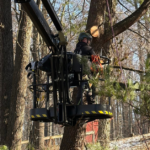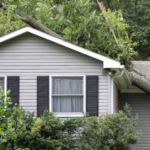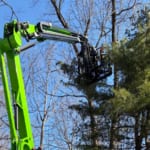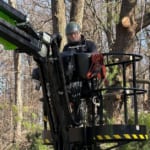
We provide structural support systems for trees that are weak, split, or at risk of failure. Cabling and bracing helps stabilize trees instead of removing them, extending their lifespan while reducing the risk of limb or trunk failure.
Serving homeowners, property managers, and municipalities across Cumberland, York, and Adams Counties.

Save a Tree With Professional Cabling and Bracing
Common Risk Conditions
Split Trunks
When a trunk begins to separate, cabling can help prevent further widening and reduce the chance of complete failure.
Co-Dominant Stems
Trees with two main leaders often develop weak attachment points that are prone to splitting under pressure.
Heavy Limb Stress
Large horizontal limbs can place excessive weight on a single attachment point, especially in mature trees.
Storm Damage Risk
Trees that have already experienced storm stress may remain structurally vulnerable even after visible damage is addressed.
Preservation of Valuable Trees
Historic, mature, or high-value landscape trees may be stabilized instead of removed when structurally viable.
The Right Support System Makes All the Difference
- High-strength cable systems: Steel or synthetic cables installed in the upper crown to limit movement of co-dominant stems and heavy scaffold branches. Installed at approximately two-thirds the height of the stems being supported. The most common supplemental support method for residential trees across Cumberland County.
- Rod bracing systems: Threaded steel rods installed through split or cracked unions to mechanically hold the wood together and prevent further separation. Used when a split has already occurred or when a union is too narrow for a cable system alone to adequately reduce failure risk.
- Combined cable and brace systems: For trees with both crown-level structural concerns and existing splits or cracks, a combined system addresses risk at multiple points simultaneously for comprehensive structural support.
Our Installation Process
How We Stabilize Trees Safely
1 Tree Assessment
We evaluate structural defects, canopy weight distribution, and failure risk to determine whether cabling, bracing, or removal is the best option.
2 Load Analysis
We assess how wind, weight, and seasonal stress affect the tree’s structure to identify support points.
3 System Design
We design a support system based on the tree’s size, species, structure, and level of risk — not a one-size-fits-all approach.
4 Installation
High-strength steel cables or rigid rods are installed at strategic points using industry-standard arboricultural methods to avoid damaging healthy tissue.
5 Final Stability Check
We verify tension, placement, and overall stability to ensure the system reduces risk without restricting healthy growth.
Get an Honest Price Before Any Work Begins
These are the real factors that affect the cost of every cabling and bracing job we estimate.
- Number of stems or unions requiring support: A single co-dominant stem is a different scope from a multi-stem tree requiring a complete crown support system
- Tree height and crown access: Taller trees require aerial lift equipment that affects both setup time and total cost
- System type: Rod bracing requires more precise installation work than a cable system and affects pricing accordingly
- Combined systems: Trees requiring both cabling and bracing involve more hardware, more installation points, and more time on site
- Inspection history: Trees with no prior structural assessment may require more thorough evaluation before system design can be finalized
We provide free on-site assessments so you receive a straight number before any commitment is made.
Trees That Benefit Most From Professional Cabling
Silver maple is the most common cabling candidate across Cumberland County properties. Fast growth produces co-dominant stems with tight V-shaped unions that split under wet snow and ice load between November and March. A cable system prevents the kind of failure that brings down a significant portion of the canopy onto structures below.
Large white oaks and red oaks on older properties throughout New Oxford, McSherrystown, and East Berlin develop heavy scaffold branches with included bark unions that weaken over decades. These trees are often irreplaceable in size and property value and are strong cabling candidates when wood condition at the anchor points is sound.
Bradford pear trees throughout York County are structurally unreliable at maturity. Cabling is rarely a long-term solution given the species’ fundamental branch weakness. We discuss this honestly during every assessment.
Trusted by Homeowners across Cumberland County, York County, and Adams County.
Mason Dixon Tree and Land Experts assesses cabling and bracing needs regularly and knows the tree species, structural failure patterns, and weather loads specific to this region.
- Owner on every job evaluates the structural situation and oversees installation
- Honest assessment of whether cabling is genuinely the right solution for your tree
- Professional-grade hardware and installation technique on every system
- Fully licensed and insured with documentation available on request
- OSHA-certified trainer on every job
- CCO crane operator certified
- Line clearance arborist certified to work around power lines
- No-surprise pricing guarantee on every written quote
- Periodic inspection recommendations are provided with every installation
- 20% off any service over $1,000 for new customers
- $100 off same-day hire for new customers